The HR Analytics Process: Turning Workforce Data into Strategic Business Decisions
- Ayesha Binte Habib
Organizations generate vast amounts of employee data every day, from attendance records and performance evaluations to recruitment metrics and employee engagement surveys. However, collecting data alone does not improve workforce performance. A business must transform raw workforce information into insights that actually support operational strategic decision-making through effective HR analytics process. The HR Analytics Process becomes a necessity because HR analytics provides a structured framework for converting workforce data into actionable intelligence. By following a defined process, organizations can identify all the KPIs that affect the business and their operational strength such as workforce trends, employee productivity, turnover, recruitment efforts and align HR initiatives with broader business objectives.
Modern businesses increasingly rely on workforce analytics to gain visibility into operational performance. Understanding the Human Resource analytics process is the first step toward building a more agile and productive workforce.
What Is HR Analytics?
HR analytics is the practice of collecting, organizing, analyzing and interpreting workforce data to improve business outcomes. It combines HR expertise with data analysis techniques to help organizations understand employee behavior, their ROI, the overall operational performance.
Unlike traditional HR reporting, which focuses on historical information, HR analytics helps organizations to uncover patterns and support proactive decision-making.
Effective HR analytics helps organizations answer questions such as:
- Why is employee turnover increasing?
- Which departments have the highest absenteeism rates?
- How can recruitment efficiency be improved?
- What factors influence employee performance?
- Which workforce initiatives deliver the highest ROI?
By answering all the above questions, HR teams move from administrative functions to strategic business partners.
The 8-Step HR Analytics Process
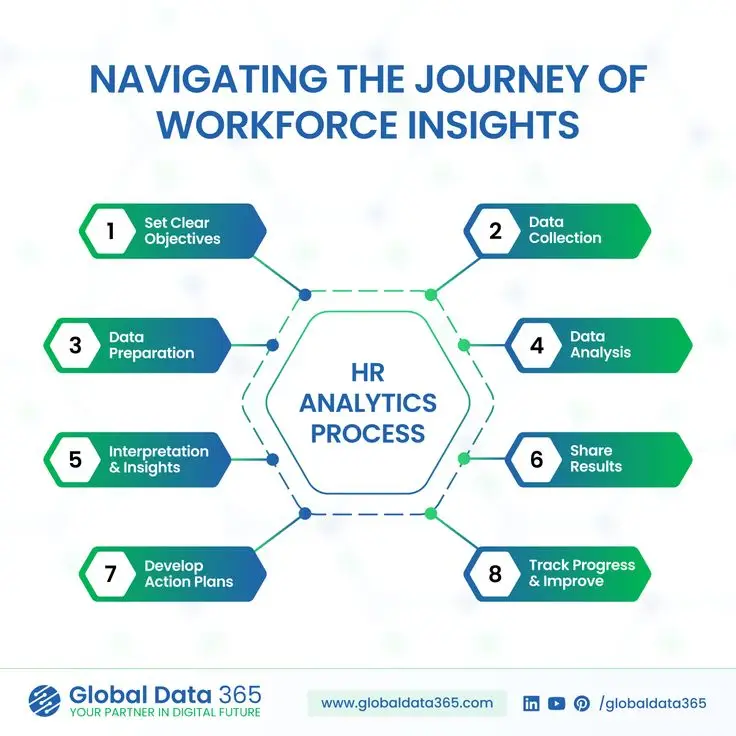
1. Set Clear Objectives
Every successful HR analytics initiative begins with a clearly defined objective. The organization must identify the workforce challenges or business goals they want to address.
Examples include:
- Reducing employee turnover
- Improving workforce productivity
- Optimizing recruitment performance
- Enhancing workforce planning
Without clear objectives, data collection and analysis can become unfocused and ineffective.
2. Collect Relevant Workforce Data
The next step involves gathering data from relevant HR systems and sources, since that works as a base for your workforce analytics planning, the data may include:
- Employee demographics
- Attendance records
- Payroll information
- Recruitment metrics
- Performance evaluations
- Learning and development records
Your data quality plays a critical role in the success of your HR analytics initiatives. With accurate and consistent data you can rely on your insights with evidence.
Payroll data is often the messiest input, especially across regions with different labor laws. Localized payroll solutions help keep this data accurate, for example by ensuring UAE gratuity and WPS compliance, before it reaches the analytics stage.
3. Prepare and Organize Data
If you have raw workforce data it might contain inconsistencies, duplicate records or missing values. Before analysis can begin, organizations must clean, standardize and organize their data.
Data preparation helps ensure:
- Consistent reporting
- Improved accuracy
- Reliable workforce metrics
- Better analytical outcomes
This stage forms the foundation for meaningful workforce analysis.
4. Analyze Workforce Data
The fundamental step; data analysis transforms workforce information into actionable insights. HR teams use analytical techniques to identify patterns, trends or any relationships within workforce data.
Common workforce analytics applications include:
- Employee turnover analysis
- Absenteeism analysis
- Recruitment funnel analysis
- Employee performance analytics
- Diversity and inclusion reporting
- Workforce productivity measurement
The goal is to uncover insights that support strategic workforce decisions for better organizational growth.
5. Interpret Findings and Generate Insights
Although analysis alone does not create value. Organizations must interpret the results within the context of their business goals.
For example, turnover analysis may reveal that employees leave after a specific tenure period. Further investigation can identify root causes such as limited career development opportunities or ineffective management practices.
This stage aligns your organizations business goals with your workforce strategy to ensure that both work on a mutual roadmap.
6. Share Results Across the Organization
Your workforce insights become valuable only when stakeholders can understand and use them. Organizations increasingly rely on HR dashboards and workforce analytics dashboards to present information through interactive visualizations and KPI tracking.
A well-designed HR dashboard enables leaders to monitor:
- Employee turnover
- Workforce productivity
- Recruitment performance
- Employee engagement
- Workforce demographics
7. Develop Action Plans
All insights should lead to measurable actions, organizations can use HR analytics findings to create targeted improvement initiatives.
Examples include:
- Employee retention programs
- Recruitment process optimization
- Leadership development initiatives
- Employee wellness programs
- Performance improvement strategies
The purpose of workforce analytics is not simply to measure performance but to improve it.
8. Track Progress and Continuously Improve
HR analytics is an ongoing process rather than a one-time project. Each organization should continuously monitor workforce KPIs and evaluate the impact of implemented actions, regular tracking helps organizations:
- Measure improvement
- Identify emerging challenges
- Adjust workforce strategies
- Improve decision-making accuracy
With continuous improvement, your workforce analytics remains aligned with changing business objectives.
The Role of HR Dashboards in Workforce Analytics
As workforce data volumes continue to grow, organizations need efficient ways to monitor and interpret workforce performance. HR dashboards serve as a centralized platform for tracking key HR metrics and workforce KPIs.
Modern HR dashboards combine multiple workforce indicators into a single view, allowing HR leaders and executives to quickly identify trends and opportunities.
Key metrics commonly tracked include:
- Employee turnover rate
- Employee satisfaction
- Workforce productivity
- Recruitment effectiveness
- Training performance
- Diversity metrics
By combining data visualization with workforce analytics, HR dashboards help organizations accelerate decision-making and improve workforce outcomes.
Building a Data-Driven HR Culture
A successful HR analytics initiative requires more than technology. The organization must build a culture that values data-driven decision-making.
This involves:
- Encouraging evidence-based HR strategies
- Improving data literacy
- Defining meaningful workforce KPIs
- Promoting transparency
- Continuously reviewing workforce performance
When HR teams adopt a data-driven mindset, workforce analytics becomes a strategic advantage rather than a reporting function.
Conclusion
The HR Analytics Process provides a structured approach for transforming workforce data into strategic business insights. By setting clear objectives, collecting relevant data, analyzing workforce trends, and continuously measuring outcomes, organizations can improve employee performance, optimize workforce planning, and drive better business results.
As businesses increasingly prioritize workforce intelligence, HR reporting and workforce planning will continue to play a central role in organizational success. Combining a robust analytics process with modern HR dashboards allows organizations to move beyond reporting and toward proactive workforce management.
Ready to transform your HR Analytics Process?
Search Blog
Related Resources
Microsoft Dynamics 365 Solution: Driving Digital Transformation