Jet Analytics Classic vs. New Jet Analytics: 10 Key Comparisons
- Ayesha Binte Habib
Organizations using Microsoft Dynamics have relied on Jet Analytics for years to centralize ERP data, simplify reporting, and improve business decision-making. Today, however, the platform has evolved significantly. Businesses evaluating their reporting strategy now face an important question: Should they continue with Jet Analytics Classic or move to the new cloud-native Jet Analytics platform?
The answer is no longer just about reporting. Modern organizations are investing in AI, Microsoft Fabric, Snowflake, Copilot, and scalable cloud data platforms. That means the underlying data architecture matters more than ever.
This guide explains the differences between Jet Analytics Classic vs. new Jet Analytics, what has changed, and how each platform fits different business requirements.
What Was Jet Analytics Classic?
Jet Analytics Classic was designed to help Microsoft Dynamics customers build a centralized SQL Server-based reporting environment. Instead of creating reports directly from ERP databases, organizations could extract data into a dedicated warehouse, transform it into a consistent structure, and publish trusted datasets for reporting.
A typical Jet Analytics Classic deployment followed this architecture:
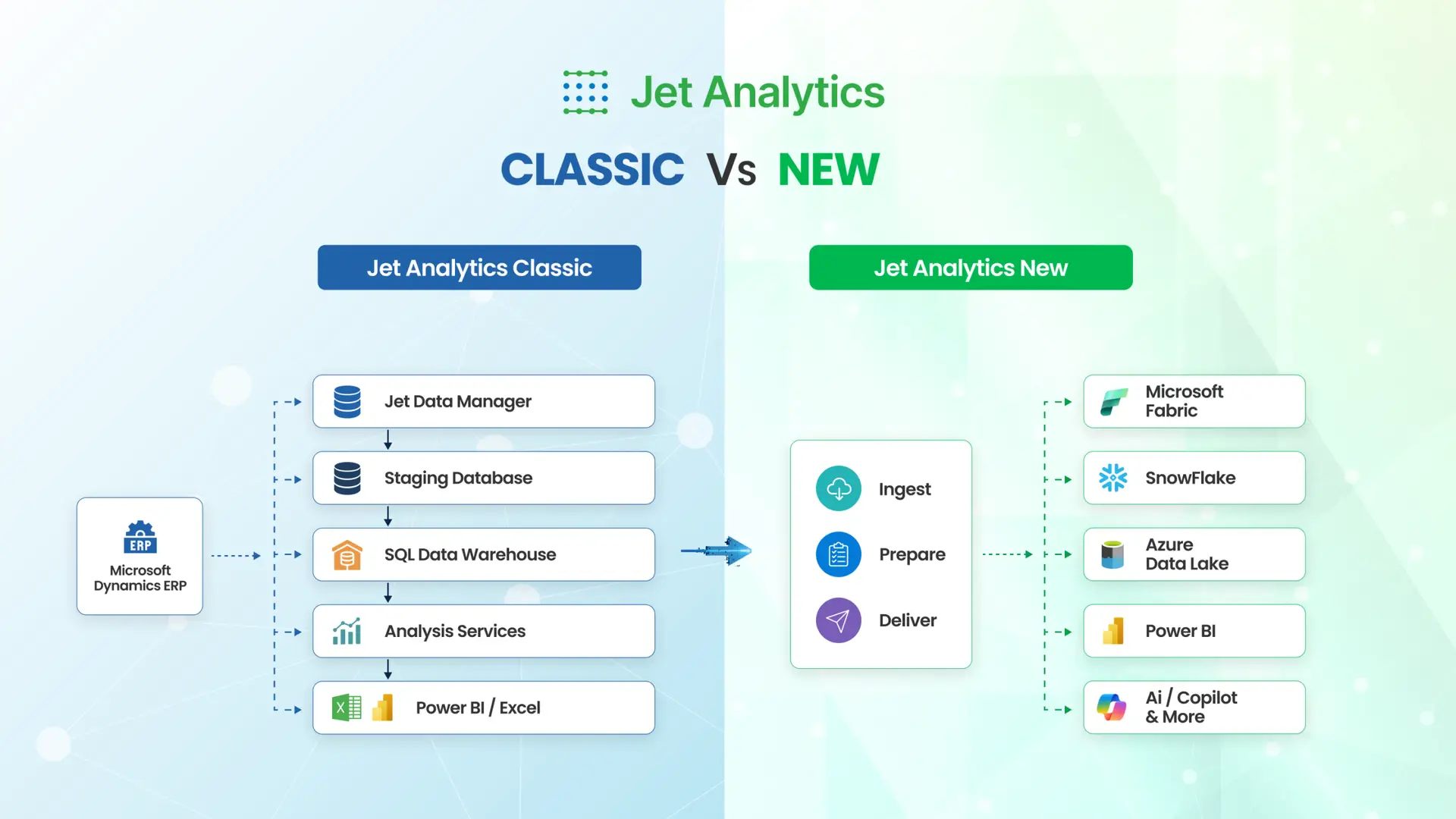
Jet Data Manager → Staging Database → SQL Data Warehouse → SQL Server Analysis Services (SSAS) → Power BI or Excel
This approach separated reporting workloads from operational ERP systems, improving both reporting performance and data consistency.
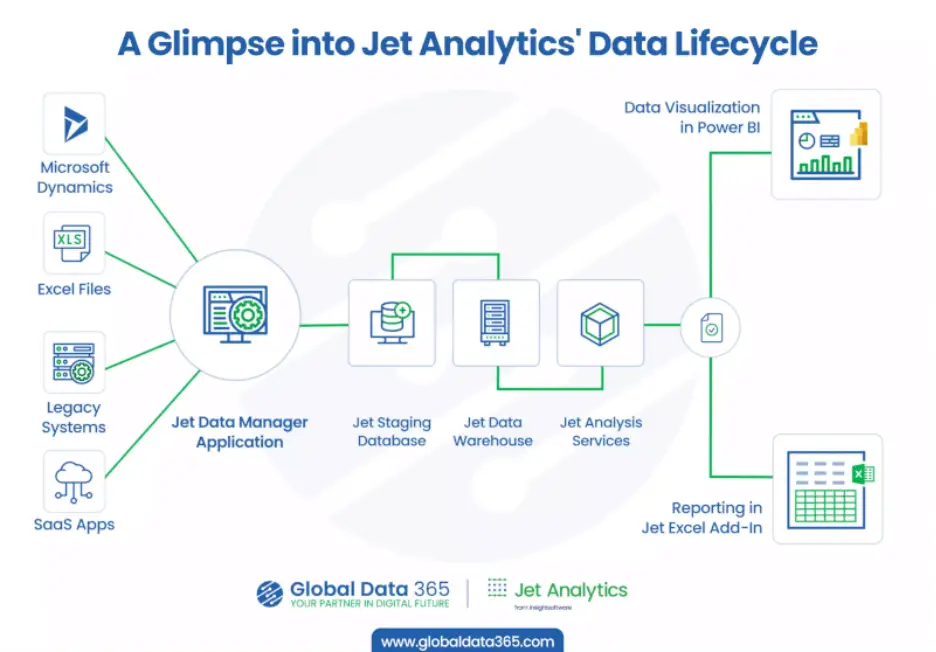
Jet Data Manager extracts data from Microsoft Dynamics ERP and other business applications. The data is first loaded into a Staging Database, where it is cleaned and standardized before moving into a centralized SQL Data Warehouse. From there, SQL Server Analysis Services (SSAS) creates optimized semantic models that Power BI and Excel use for fast, governed reporting. By separating reporting from the live ERP database, organizations can generate complex reports without affecting transactional performance.
For many organizations, Jet Analytics Classic became the standard enterprise reporting tool because it automated data warehouse creation while reducing manual SQL development.
Why Jet Analytics Classic Was Successful?
Jet Analytics Classic solved several common reporting challenges for Microsoft Dynamics users. Instead of building SQL scripts manually, organizations could automate data extraction, create repeatable ETL processes, and maintain consistent reporting models across departments.
It also introduced governed dimensions, standardized measures and reusable business logic, reducing the number of conflicting reports generated across finance, operations and management teams.
For businesses running SQL Server infrastructure, this architecture provided a reliable and well-understood foundation for enterprise reporting.
Where Jet Analytics Classic Shows Its Age?
Business intelligence has changed considerably over the last decade.
Organizations are no longer building reporting environments solely for dashboards. They are preparing data for machine learning, AI assistants, Copilot experiences, predictive analytics, and cloud-native applications.
Traditional SQL Server data warehouses remain effective for reporting, but they require additional work when integrating with platforms like Microsoft Fabric, Snowflake, or modern cloud data lakes.
As companies start using cloud setups keeping many ETL processes, systems and manual connections gets harder and harder. This change is one of the reasons the new Jet Analytics platform was created.
What Is the New Jet Analytics?
The new Jet Analytics is a cloud-native data integration platform built through insightsoftware’s expanded partnership with TimeXtender.
Rather than focusing only on building SQL Server warehouses, the platform helps organizations create an AI-ready data foundation that supports reporting, analytics, cloud platforms, and future AI initiatives.
Instead of a warehouse-first approach, the platform follows a modern workflow:
Ingest → Prepare → Deliver
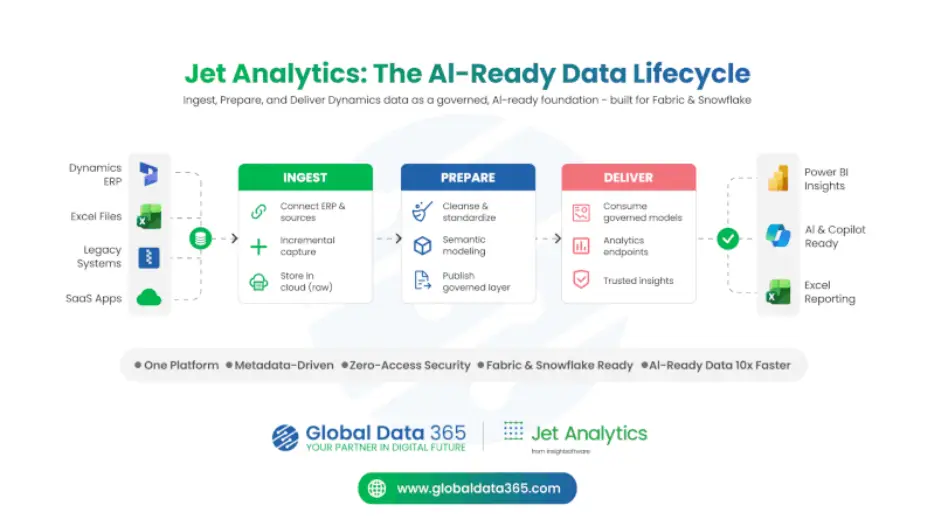
Data is first ingested from Microsoft Dynamics, cloud applications, databases and other business systems. It is then prepared using automated data transformations, business rules, and governance, with support for Spark and PySpark without requiring extensive coding. Finally, the curated data is delivered to modern platforms such as Microsoft Fabric, Snowflake, Azure Data Lake and Power BI, where it becomes available for reporting, analytics, machine learning, and Copilot experiences.
This framework allows organizations to collect data from multiple business systems, transform it using governed pipelines, and publish trusted data to platforms such as Microsoft Fabric, Snowflake, Azure Data Lake, Power BI and other analytical environments.
The result is a flexible cloud data platform that supports both traditional reporting and modern analytics.
A Modern Data Platform Instead of Just a Data Warehouse
The biggest change is philosophical. Jet Analytics Classic focused on creating a reporting database. The new Jet Analytics focuses on creating a governed, reusable data foundation that serves multiple consumers simultaneously.
Instead of preparing data separately for Power BI, AI projects, data science teams, and business users, organizations prepare data once and deliver it wherever it is needed.
This approach aligns closely with today’s modern data stack, where trusted data becomes a shared organizational asset instead of existing inside isolated reporting systems.
Jet Analytics vs New Jet Analytics: Architecture Comparison
Jet Analytics Classic follows a structured SQL Server architecture that is highly effective for organizations committed to Microsoft SQL infrastructure.
The new Jet Analytics introduces a more flexible architecture capable of connecting cloud storage, distributed processing engines, and multiple analytics platforms without requiring organizations to redesign their data strategy every time a new technology is introduced.
Rather than replacing proven governance practices, it extends them into modern cloud ecosystems.
10 Comparison: Jet Analytics Classic vs. New Jet Analytics
Here are the top 10 features that create difference between the classic jet analytics that you used and the new AI-Ready Jet Analytics.
| Feature | Jet Analytics Classic | New Jet Analytics |
|---|---|---|
| Architecture | SQL Server Data Warehouse | Cloud-native data platform |
| Primary Focus | Enterprise reporting | AI-ready data foundation |
| Deployment | Mostly on-premises or hosted SQL | Cloud-first and hybrid |
| Data Processing | SQL Server ETL | Automated cloud pipelines |
| Data Delivery | SSAS, Power BI, Excel | Microsoft Fabric, Snowflake, Azure Data Lake, Power BI |
| AI Readiness | Limited | Designed for AI and Copilot workloads |
| Security | SQL-based permissions | Zero-access security architecture |
| Transformation | SQL workflows | No-code Spark and PySpark transformations |
| Scalability | SQL Server dependent | Cloud-scale architecture |
| Ideal For | Traditional reporting | Modern analytics and AI initiatives |
Microsoft Fabric Integration
One of the things about this is that it supports Microsoft Fabric right out of the box.
A lot of companies are using Microsoft Fabric for reporting and other things like data engineering and artificial intelligence because it has everything they need in one place. This means they can do things like look at data lakes and analytics and engineering and governance and business intelligence all at the time.
The new Jet Analytics proves to be helpful because it lets companies get their ERP data ready and put it into Microsoft Fabric without having to do a lot of extra work to make it all connect. This makes it easier to get started with reporting and people can use their ERP information right away with things, like Power BI and Copilot and other advanced analytics tools.
For companies that are starting to use Microsoft Fabric this is a deal because it makes it a lot simpler to get their ERP data ready and use it with Microsoft Fabric.
Snowflake Support
Modern companies often keep their data inside Snowflake because it can handle a lot of information and works faster. The new Jet Analytics works with Snowflake as a place to send data so companies can get Microsoft Dynamics data together with CRM, finance, HR, manufacturing and other kinds of data.
Rather than having separate reporting databases businesses can create one single data system where all the different teams use the same correct information. This feature makes Jet Analytics a better tool for data warehouses, for companies that are focused on using the cloud.
AI-Ready Data Foundation
Artificial intelligence depends on trustworthy data.
With poor governance, duplicate records, inconsistent business definitions and disconnected systems, all of them results in the reduced and poor quality of AI-generated insights.
The new Jet Analytics focuses on preparing clean, governed and reusable datasets before they reach AI applications. This is what many vendors now describe as an AI-ready data foundation. Instead of using raw data from enterprise resource planning systems companies are now using standardized business information that is ready to use. This helps to make the AI output more consistent and reliable. It also makes it easier to track where the information is coming from and to have confidence in the results that AI systems are producing.
This is where the AI ready data foundation comes in it helps companies to get the most out of their intelligence systems.
Faster Data Pipelines
Building traditional ETL processes often requires significant SQL development, manual documentation, and ongoing maintenance. The new Jet Analytics automates much of this work using metadata-driven development and no-code transformation capabilities.
Companies can manage data pipelines quickly while keeping everything in order, across different environments. When the needs of the business change people can make these changes in one place of having to redo many separate connections this results in dramatically shorter implementation cycles and easier long-term maintenance.
Zero-Access Security
Security requirements continue to increase as organizations adopt cloud platforms.
The new Jet Analytics introduces a zero-access security model designed to reduce unnecessary exposure to production data.
Instead of granting broad access to operational databases, data is governed through managed pipelines and controlled delivery mechanisms. This improves compliance while allowing data teams, analysts, and business users to work from trusted datasets without compromising operational systems.
Governed Semantic Layer
Reporting becomes inconsistent when different teams calculate the same KPI differently.
A governed semantic layer solves this problem by defining business metrics once and making them available across reporting tools.
When people make dashboards in Power BI or look at data through Microsoft Fabric everyone is working with the definitions. This really helps to cut down on arguments about reports. It also makes people feel more confident when big decisions are made by executives.
For companies that have to deal with a lot of reports having a governed layer in place is a really smart thing to do it is one of the best things they can do for the long run, for Power BI and Microsoft Fabric and all the reports they have to manage.
Governed Semantic Layer
Reporting becomes inconsistent when different teams calculate the same KPI differently.
A governed semantic layer solves this problem by defining business metrics once and making them available across reporting tools.
When people make dashboards in Power BI or look at data through Microsoft Fabric everyone is working with the definitions. This really helps to cut down on arguments about reports. It also makes people feel more confident when big decisions are made by executives.
For companies that have to deal with a lot of reports having a governed layer in place is a really smart thing to do it is one of the best things they can do for the long run, for Power BI and Microsoft Fabric and all the reports they have to manage.
Jet Analytics for Microsoft Dynamics Data Warehousing
Microsoft Dynamics environments often include finance, sales, purchasing, inventory, manufacturing, and operations data spread across multiple modules.
The new Jet Analytics simplifies data warehousing by bringing these datasets together into a governed platform ready for reporting and analytics.
Organizations can also bring in systems that are not part of Dynamics. This means they have one place to get all the information they need of having to deal with separate reporting systems that are not connected. This makes the platform a good choice for businesses that want to do more, than report on their ERP.
Should You Stay with Jet Analytics Classic?
Jet Analytics Classic remains a strong solution for organizations with stable reporting requirements.
It continues to make sense when businesses:
- Operate entirely on-premises
- Depend heavily on SQL Server infrastructure
- Have mature SSAS reporting environments
- Do not plan immediate cloud or AI initiatives
- Prefer maintaining existing reporting investments
For these organizations, Classic still delivers reliable enterprise reporting for decisions that matter.
When Should You Move to the New Jet Analytics?
When migration becomes much more compelling since organizations are modernizing their data strategy time to time.
The new platform is an excellent fit when businesses:
- Are adopting Microsoft Fabric
- Plan to use Snowflake
- Want an AI-ready data platform
- Need faster data integration
- Are replacing legacy ETL processes
- Want to simplify cloud deployments
- Need scalable governed data pipelines
- Plan to use Microsoft Copilot with business data
The move is not simply an upgrade but it represents a shift toward a modern data architecture.
Does Migration Mean Starting Over?
A common concern is whether moving from Jet Analytics Classic requires rebuilding every existing report.
In most cases, the answer is no.
Organizations can migrate incrementally by preserving reporting logic, reusing business definitions where appropriate and modernizing the underlying data platform over time.
The migration strategies vary depends on existing architecture, customizations and reporting requirements, but businesses do not necessarily need to replace everything simultaneously. A phased migration typically delivers lower risk while allowing teams to continue using existing reports during the transition.
Final Thoughts
Comparing Jet Analytics Classic vs. new Jet Analytics is really a comparison between two generations of enterprise data architecture.
Jet Analytics Classic was designed to build trusted SQL Server reporting environments.
The new Jet Analytics is designed to build governed, cloud-native, AI-ready data foundations that support reporting, analytics, Microsoft Fabric, Snowflake, and future AI initiatives.
Neither platform is universally better. The right choice depends on your organization’s infrastructure, cloud strategy, reporting maturity, and long-term data goals.
However, for organizations investing in AI, cloud analytics, or Microsoft Fabric, the new Jet Analytics provides a stronger foundation for the future.
Frequently Asked Questions
Is Jet Analytics Classic still supported?
What is the difference between Jet Analytics Classic and the new Jet Analytics?
Jet Analytics Classic is a SQL Server-based enterprise reporting platform focused on building traditional data warehouses vs the new Jet Analytics is a cloud-native data integration platform that supports Microsoft Fabric, Snowflake, AI-ready data, governed pipelines, and modern cloud architectures.
Does the new Jet Analytics support Snowflake?
Yes. The new Jet Analytics supports Snowflake as a native cloud destination, making it easier to prepare ERP data for enterprise analytics without building custom integrations.
Can Jet Analytics connect Microsoft Dynamics to Microsoft Fabric?
What is an AI-ready data foundation?
What is an AI-ready data foundation?
Ready to Modernize Your Data Platform?
Whether you’re evaluating Jet Analytics Classic vs New Jet, planning a migration to the new Jet Analytics or building an AI-ready data foundation with Microsoft Fabric or Snowflake, the right implementation strategy makes all the difference.
Global Data 365 helps organizations assess their current environment, design scalable data architectures, and implement modern Jet Analytics solutions that support reporting today and AI initiatives tomorrow.
Talk to Experts and discover which Jet Analytics approach best fits your business.
Search Blog
Related Resources